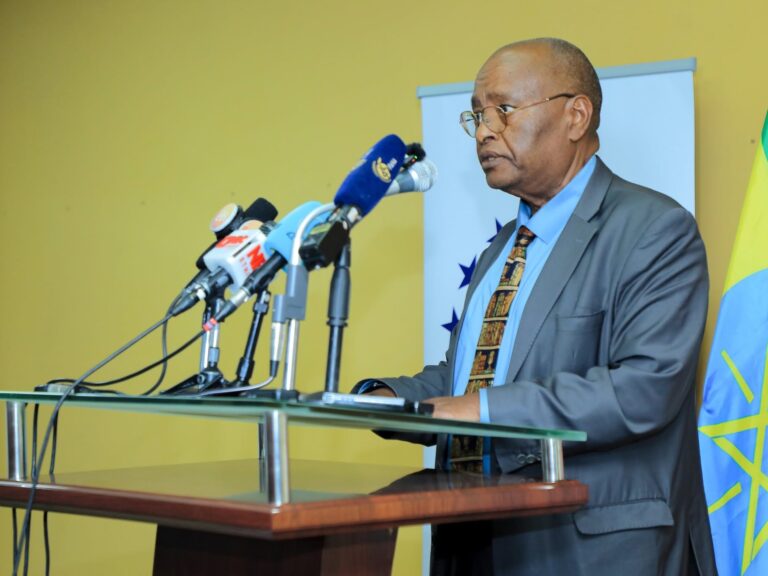
A delegation from the United States Embassy in Ethiopia made a formal visit to the Ethiopian Academy of Sciences (EAS) on 13 December 2025, signifying growing cooperation between the scientific community in Ethiopia and global diplomatic establishments for evidence-informed policy-making.
It was headed by Dr. Jonathan Koehler, the Public Diplomacy Officer at the U.S. Embassy, and also included members such as Eyerusalem Mandefro, the Professional Exchanges Coordinator at the U.S. Embassy, and Dr. Walter McCollum, the President of the Fulbright Association. In the course of the visit, the guests were greeted by Prof. Belay Kassa, the President of the EAS, who also presented an outline of the workings and the achievements of the EAS and its contribution to the provision of science-driven advice to the Government of Ethiopia.

Prof. Belay emphasized that the Academy does not and cannot function in a vacuum but, instead, as a trusted advisor of government agencies. In that way, results of EAS research findings shape the country’s policy, and the government budget supports research that is aligned with national needs.
The delegation was made aware of the infrastructure and developmental status of the Academy. The present site of the Ethiopian Academy of Sciences is a donation from the government of Ethiopia, which is viewed as very generous, reflecting the government’s confidence in the mission of the Academy.
One of the key areas of discussion was the important role played by EAS in the development of a national guideline for the awarding of honorary degrees, which is currently adopted by the Ministry of Education. This guideline sets up a set of clear criteria that will address any previous concerns raised over inconsistencies and nepotism within the governance structures of higher education institutions. This guideline has now been validated and will serve as a guiding tool for all universities in Ethiopia.
The Academy has emphasized its continued contributions to key national reforms with significant policy implications, such as studies underpinning changes to the National Population Policy of Ethiopia, first formulated in 1994. Such informed contributions are currently helping the Ministry of Planning & Development to upgrade this politically contested and high-priority policy document.
Moreover, EAS has also mentioned the effective implementation of capacity-building programs by the Academy together with its international collaborators. Supported by GIZ, the Academy has so far helped 15 public universities of applied sciences improve their leadership, organizational performance, and institutional effectiveness. There has been positive feedback from the institutions involved in a project undertaken jointly.
Mr. Zalalem Yimenu, coordinator of the academy’s autonomy project, noted that the academy is implementing a two-year initiative to support the transition of Ethiopia’s public universities to autonomous governance in collaboration with the American Embassy.

He also spoke about the completed projects funded by GIZ and the Public Diplomacy Office of the U.S. Embassy, and plans by EAS to extend its services to applied science universities in Ethiopia with funding from the U.S.
Dr. Tibebeselassie Seyoum, the Vice Executive Director of the EAS, mentioned that World Art Day and Ethio Jazz Day are annually organized by the EAS in partnership with the Addis Ababa Culture, Arts, and Tourism Bureau. He posed a question about the possibility of such collaborations with the U.S. Embassy.

During the discussion, Dr. Jonathan Koehler, Public Diplomacy Officer at the U.S. Embassy in Ethiopia, recalled the long-standing diplomatic relations between Ethiopia and the United States and stated that the two countries will continue to strengthen their 120-year-old cooperation in education, health, and the economy.

The delegates praised the Academy’s commitment to integrity in science, policy orientation, and inter-institutional interaction. Discussion culminated in exploring avenues for continued engagement in science, higher education, and evidence-based development projects.