The Ethiopian Academy of Sciences (EAS) December 4, 2025, held a workshop in Addis Ababa on “Understanding Implications of society’s folklore Resources for Use in Demographic and Gender Policy Making.” The workshop was organized with the financial support of the Packard Foundation and reflected the Academy’s ongoing commitment to generating evidence that supports gender and demographic policy development.
The workshop brought together researchers with experience in folklore and gender studies, representatives from the Packard Foundation, and senior leaders and experts from the Academy. The discussion emphasized how cultural expressions, oral narratives and other forms of folklore continue to shape societal perceptions, influence norms and offer insights relevant to policy formulation.
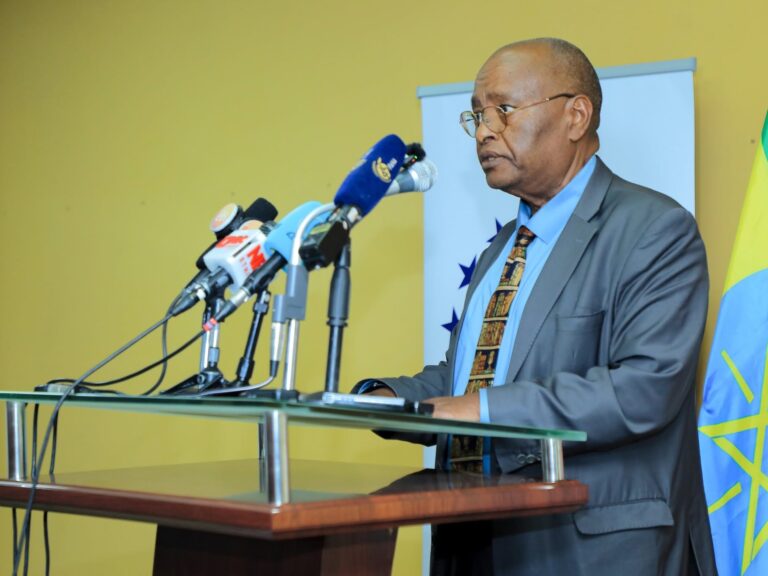
Prof. Teketel Yohannes, Executive Director of the Academy, opened the workshop with remarks highlighting the EAS’s broad expertise in natural sciences, social sciences, humanities, engineering, and agriculture. He noted that the Academy has continued to conduct platforms that support national development by organizing artistic forums, policy input workshops, and capacity-building programs through its Creative Arts Center, established in honor of the late Bilaten Geta Hiruy Wolde-Selassie. He reiterated that the Academy views cultural knowledge as a critical input for long-term policy making.

The output of the study was presented by Dr. Frehiwot Bayu. Her presentation is based on the results of the project that aims to collect, classify and interpret proverbs, narratives, myths and wider oral traditions related to gender and population This work is part of an evidence-based study supported by the Packard Foundation to generate evidence that helps policymakers to better understand how cultural norms shape attitudes and behaviors across Ethiopian communities.
The study is also linked to the Academy’s long-term study program on population and development, which has been active since 2016. The goal is to document societal knowledge in a way that strengthens national population and gender strategies and ensures traditional narratives are properly analyzed and used to inform policy directions.
Review feedback on the study was presented by Dr. Yenealem Aredo and Professor Zelalem Lieyew. Both forwarded professional comments aimed at improving the structure, content and the evidence base and policy value of the study. A moderated discussion led by Dr. Mohammed Ali followed the presentations giving participants the opportunity to ask questions, provide comments and highlight areas where further analysis may add value.
Participants also underscored the importance of organizing the collected oral literature on a scientific scale, evaluating the advantages and limitations of cultural narratives and ensuring that the final study meets high professional standards. The discussion emphasized that the study is expected to contribute to broader national objectives, including improved gender policies, stronger population programs and a deeper understanding of how folklore can serve as a practical tool for government, academia and civil society
The workshop concluded with a collective expression of diverse ideas and opinions on the next steps. These include refining the study, integrating reviewer recommendations and preparing the final research output that will serve as a resource for policymakers, researchers and institutions working on gender and population changes. The Academy reaffirmed its commitment to enhance using indigenous knowledge to build forward-looking and culturally grounded policy insights.